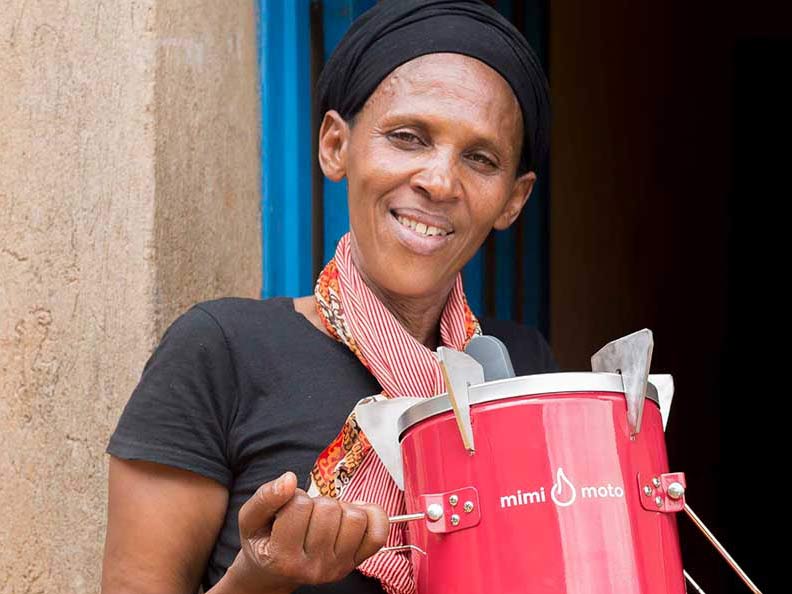
Lendwithcare is currently supporting the distribution of improved cookstoves in three countries: India, Rwanda, and Chad. In India, there are three types of cookstoves provided, the Greenway Jumbo, Greenway Smart and Sarala. Their cost price is around US$30 each. In Rwanda only one type of cookstove is being provided, which is manufactured by Mimi Moto. These cost around US$75 each. In both countries there are costs associated with requesting Gold Standard and Fairtrade verification, and the operational costs of our local partners. The stoves in India can use solid biomass such as wood and dry dung, but use much less than traditional mud cookstoves, making them much more efficient in producing energy. More information is available here. In Rwanda, pellets are used for cooking rather than wood or charcoal. The Mimi Moto stoves are higher tier cookstoves, and you can see how they work here.
In India, cookstove recipients will significantly reduce the time they spend collecting biomass such as firewood as much less will be needed. This is an activity mainly undertaken by women and girls at present. In Rwanda, the cookstove recipients are urban and peri-urban, meaning the purchase of charcoal will be commonplace for them. Our local partner organisation, BioMassters provides all recipients with one month’s supply of pellets (which are made from compacted sawdust) for free. Afterwards, pellets need to be a bought at a reasonable cost. Per kilogram, pellets cost around 10 US cents less than charcoal. Furthermore, the improved cookstoves possess greater thermal efficiency than traditional cookstoves, so fewer pellets are required to cook with.
The pellets provided by BioMassters are manufactured from biomass waste that is left over from forest management, reforestation and furniture production. By using this resource, there is less pressure on local forests which are being deforested because of charcoal production.
In Chad, Lendwithcare supports the distribution of solar cookers in the refugee camps of Iridimi and Touloum, near the border with Sudan. The Haines Pop-Open solar cookers used in the project are produced by Haines Solar Cookers.
- They are designed in the United States, manufactured in China, and shipped to Chad. Crucially, the final assembly of the cookers takes place within the camps and is carried out by women refugees, creating income-generating opportunities and strengthening local ownership. In addition, the blue cover bags are produced locally in the camps rather than imported, further supporting skills development and local value creation within the refugee communities.
- These cookers work by concentrating sunlight onto a black cooking pot, allowing households to cook cleanly with the power of the sun. They are simple, robust and well suited to humanitarian settings. The cost per unit is approximately US$30, depending on procurement and transport costs. As with other countries, there are additional costs related to distribution, training, monitoring and carbon certification.
- The solar cookers are used alongside traditional cooking methods and help households reduce firewood use by around 50%, saving about one tonne of wood per household per year. This reduces pressure on local ecosystems and significantly lowers the need for firewood collection outside the camps, an activity that often exposes women and girls to serious security risks. As a result, they benefit from improved personal safety, a reduced workload and less exposure to harmful smoke.
Next: What do the climate positive cookstoves and solar cooker look like? >
We're proud to introduce a new way to support low-income families most at risk of climate change through Lendwithcare. Find out more about making a grant today.